Free 2nd grade worksheets

Stories with packs, boxes and rows worksheets

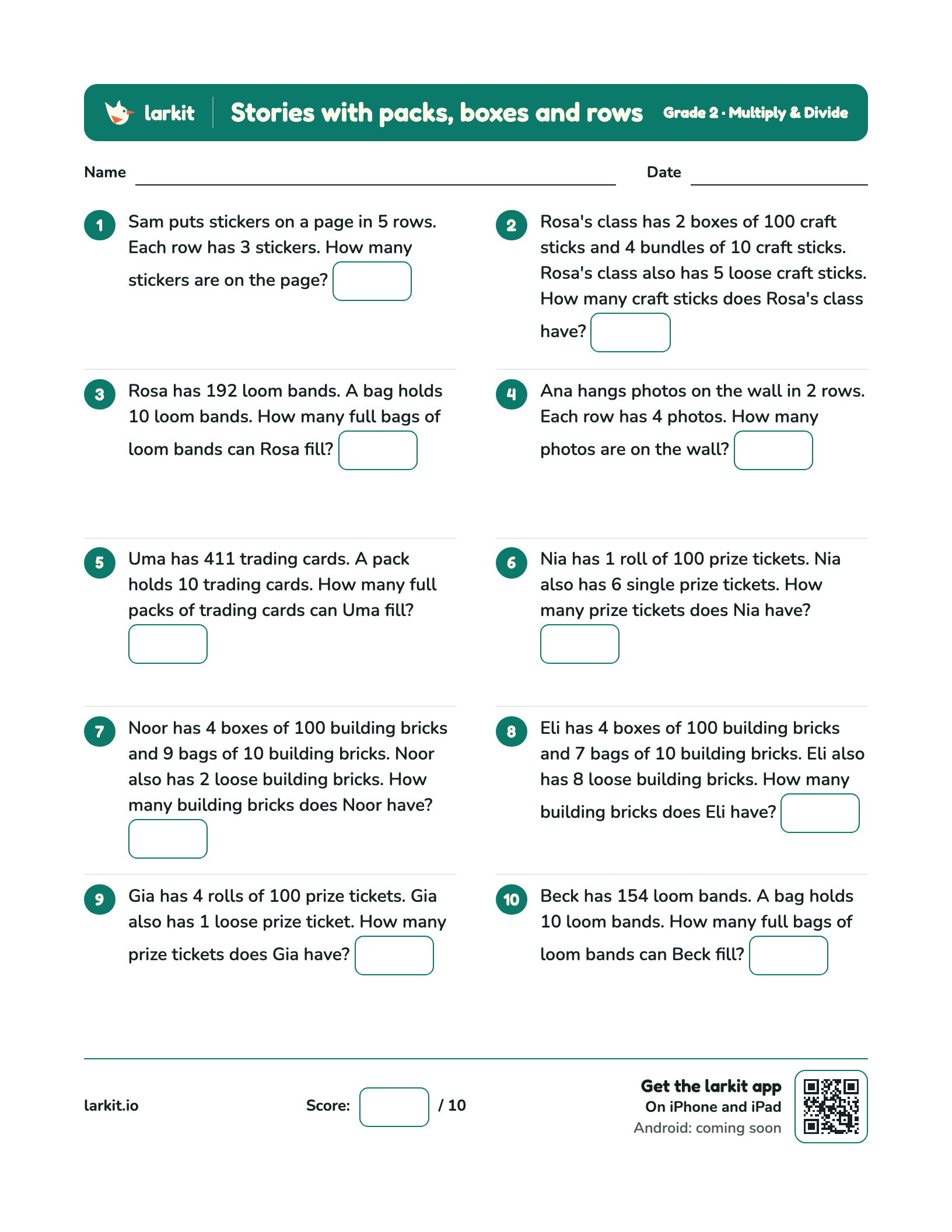
2 printable PDFs, each with its answer key. Stories with boxes of 100, strips of 10 and loose ones, like 4 boxes of 100 craft sticks and 8 loose.
  • 2 free PDFs
  • 10 questions each
  • Answer keys
  • US Letter
  • No sign-up
Stories with packs, boxes and rows: free 2nd grade math worksheet, sheet 1
+ answer key

Both free sheets

What's on the sheet

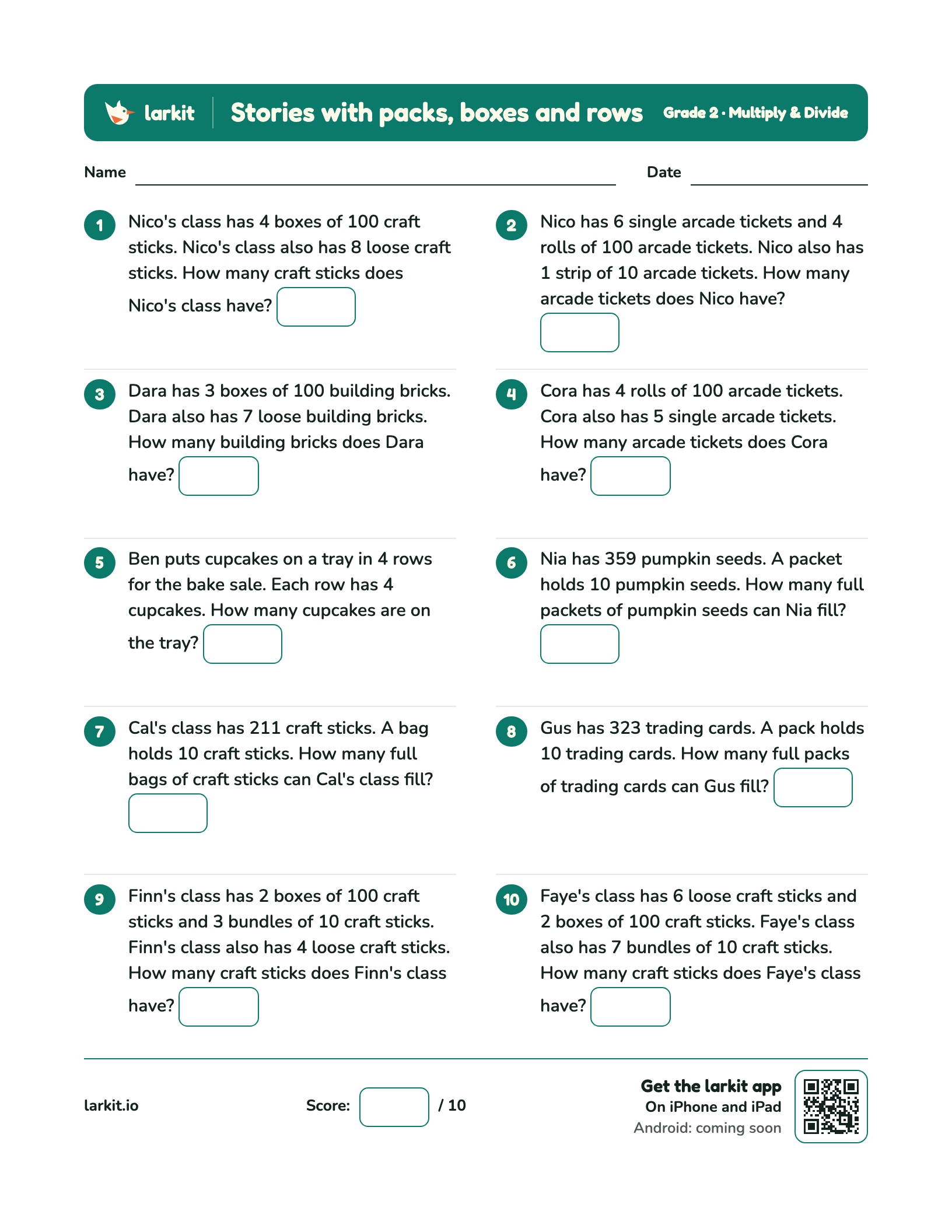
10 questions on US Letter paper, with a box for the score. Some from sheet 1:

  1. Nico's class has 4 boxes of 100 craft sticks. Nico's class also has 8 loose craft sticks. How many craft sticks does Nico's class have?Answer: 408
  2. Nico has 6 single arcade tickets and 4 rolls of 100 arcade tickets. Nico also has 1 strip of 10 arcade tickets. How many arcade tickets does Nico have?Answer: 416
  3. Dara has 3 boxes of 100 building bricks. Dara also has 7 loose building bricks. How many building bricks does Dara have?Answer: 307
  4. Cora has 4 rolls of 100 arcade tickets. Cora also has 5 single arcade tickets. How many arcade tickets does Cora have?Answer: 405

Helping at home

Nico's class has 4 boxes of 100 craft sticks and 8 loose sticks, so it has 408. These stories show place value in real packs: rolls of 100 tickets, strips of 10 and single ones. Second graders put the groups together into a 3-digit number, and some stories list the groups out of order.

A missing tens place is the trap. With 4 hundreds and 8 ones, kids often write 48, forgetting the zero tens. When the story lists ones first, some write the digits in the order they appear.

Have your child draw squares for hundreds, lines for tens and dots for ones, then write the number. Ask, "How many tens are there?" before writing. Real money works too: 4 dollar bills, no dimes and 8 pennies is $4.08.

2nd grade word problems, step by step

All word problems sheets →
  1. Step 1 · earlierAdd and take away stories
  2. Step 2 · earlierPart and whole stories
  3. Step 3 · earlierCompare stories
  4. Step 4 · earlierFind the missing number
  5. Step 5 · before thisTwo-step stories
  6. Step 6 · you're hereStories with packs, boxes and rows
  7. Step 7 · nextFraction stories
  8. Step 8 · laterStories with bigger numbers
  9. Step 9 · laterShare into equal groups