Free printable
Subtraction chart to 20
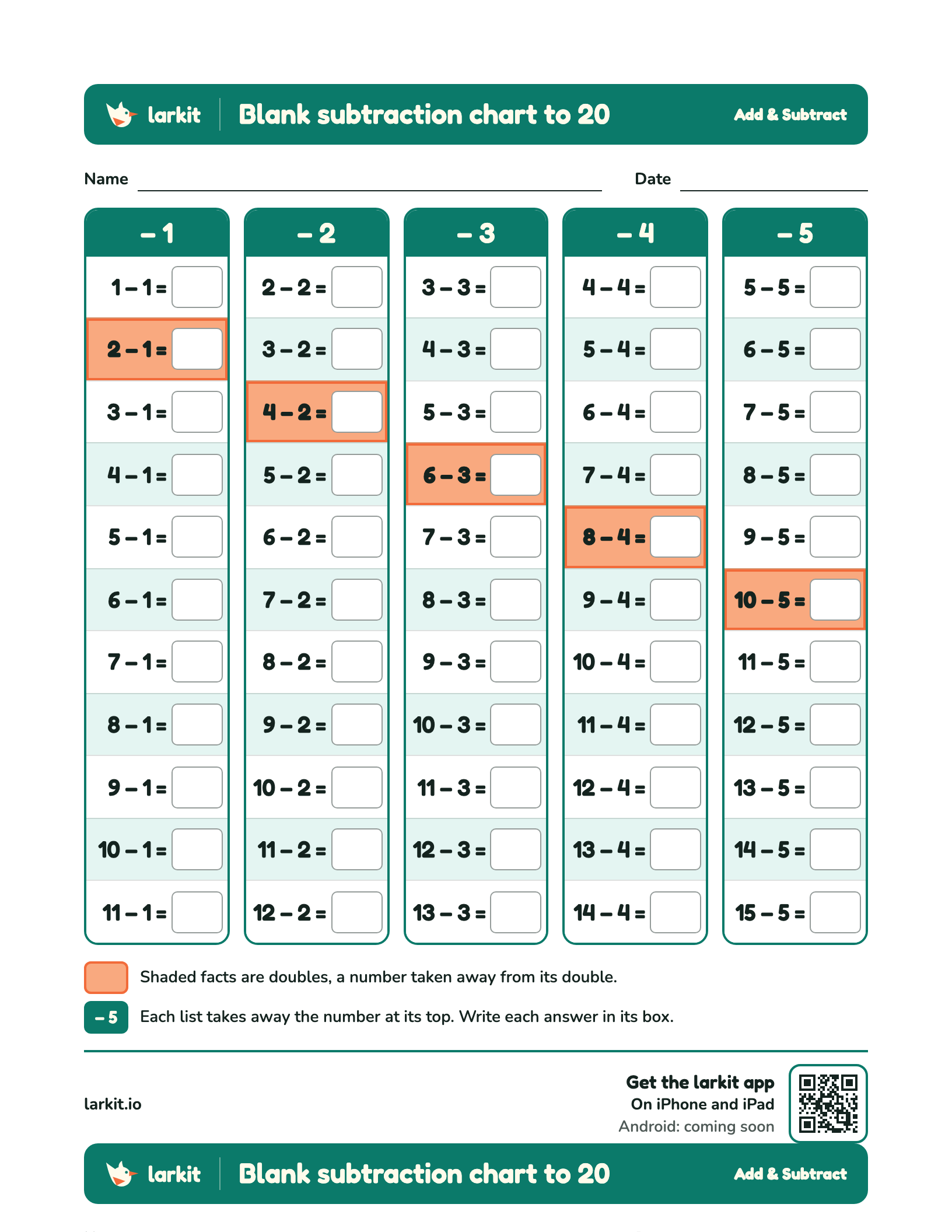
Here are the subtraction facts children learn in 1st and 2nd grade, from 1 − 1 to 20 − 10, in ten lists on one page. Each list takes away one number, so its answers count up from 0 to 10. There's a blank chart too, for your child to fill in and check against the full one.
- 2 free PDFs
- Blank chart too
- US Letter
- No sign-up
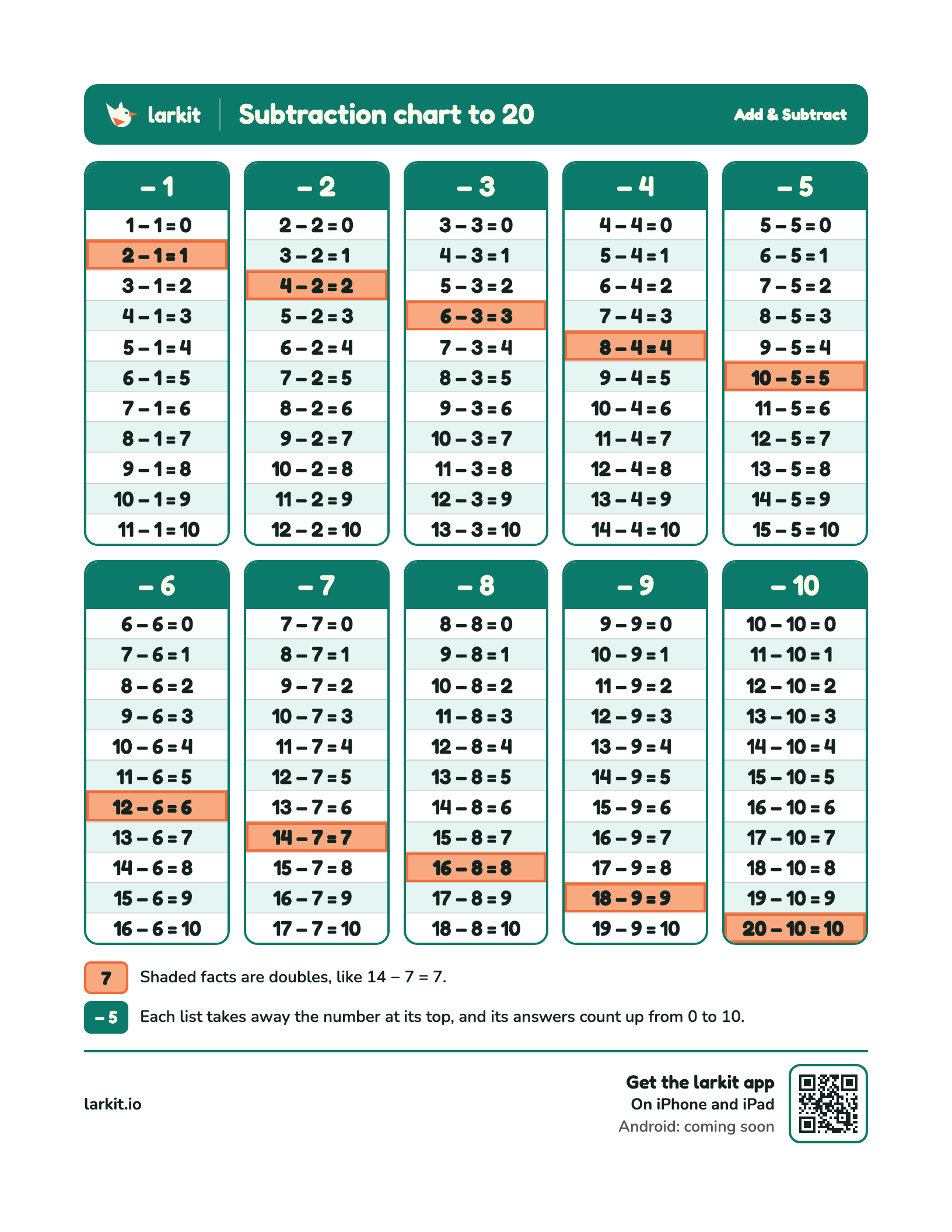
Every fact from 1 − 1 to 20 − 10
Tap any fact to see the other facts in its family.
13 − 5 = 8
So 8 + 5 = 13 and 13 − 8 = 5.
− 1
− 2
− 3
− 4
− 5
− 6
− 7
− 8
− 9
− 10
Patterns on the subtraction chart
Count up the list
Each line starts 1 higher than the line above it, and its answer is 1 higher too. Once your child sees that, a whole list follows from any fact they know.
Doubles
The shaded fact in each list is a double: 14 − 7 = 7, because 7 + 7 = 14. Doubles are some of the first subtraction facts children know by heart.
Take away 10
Taking 10 from a teen number leaves its ones: 17 − 10 = 7 and 13 − 10 = 3. The − 10 list shows it for every teen, from 11 − 10 = 1 to 19 − 10 = 9.
Take away 9
Taking 9 takes 1 less than taking 10, so the answer is 1 more. Since 15 − 10 = 5, the answer to 15 − 9 is one more, 6.
Back to ten
For 13 − 5, take 3 to get back to 10, then take the other 2: 13 − 3 = 10 and 10 − 2 = 8. First graders learn to subtract this way.
Think addition
Each subtraction fact has an addition fact in its family. To find 12 − 4, ask what number plus 4 makes 12. It's 8, since 8 + 4 = 12, so 12 − 4 = 8.
Blank subtraction chart to 20
Ten lists of subtraction facts to 20 with the answers left empty, on two pages.See the blank chart →Learning subtraction facts at home
Start with the lists most children find easiest: take away 1, take away 2 and take away 10, then the doubles. On the blank chart, the lists your child can fill in quickly show what they know, and the slow ones show what to practice.
Read a list out loud together, then cover its answers with a strip of paper and try again. Sliding the strip down one line at a time turns the chart into a quick game.
Keep the addition chart nearby. When your child gets stuck on 15 − 7, have them go down the 7 column on the addition chart to 15. It's in the 8 row, so 15 − 7 = 8.
Subtraction chart questions parents ask
Why does the chart stop at 20?
Subtracting within 20 is what children learn to do quickly in 1st and 2nd grade. The chart undoes every sum from the addition chart, so its biggest fact is 20 − 10 = 10. Taking away 0 changes nothing, so the chart leaves it out.
What grade learns subtraction facts?
In most US schools, children subtract within 10 fluently by the end of 1st grade and within 20 by the end of 2nd grade, with strategies like getting back to 10 and thinking of the addition fact.
How do I use the blank chart?
Print the blank chart and let your child write each answer in its box, one list at a time or the whole chart. The blank chart takes two pages, take away 1 to 5 and then 6 to 10, so every box has room for a child's handwriting. The full chart is the answer key.
Will it print in black and white?
Yes. The list heads and the shaded doubles stay clear on a black-and-white printer. The full chart fits one US Letter page with 3/4-inch margins, and the blank chart fits two.
Is the chart free?
Yes. The subtraction chart and its blank version are free to download and print, and you don't need to sign up.
Subtraction worksheets
Free sheets for the facts on the chart, each with its answer key.